The Last Supper Painting 5 Visual Elements of Art
While having the concluding meal with his disciples, Jesus declared, "Very truly I tell you, one of yous is going to betray me," (Gospel of John 13:21). The 12 apostles of Jesus reacted when they heard these words. Beneath, nosotros look at i of the most intricate visual representations of this Biblical account: The Last Supper painting, by the Italian Renaissance creative person, Leonardo da Vinci.
Table of Contents
- 1 Artist Abstract: Who Was Leonardo da Vinci?
- ii The Final Supper by da Vinci in Context
- 2.1 Contextual Analysis: A Brief Socio-Historical Overview
- 2.2 Formal Analysis: A Brief Compositional Overview
- 3 Facts About The Last Supper Painting
- 3.ane Da Vinci's Preparatory Sketches
- three.two Copies of The Concluding Supper Original
- 3.3 Conspiracy Theories Almost The Concluding Supper Painting
- 4 Standing the Tests of Time
- 5 Oftentimes Asked Questions
- 5.ane Who Painted The Last Supper?
- 5.2 Where Is The Concluding Supper Painting by Leonardo da Vinci?
- 5.3 Why Is The Last Supper by da Vinci Falling Apart?
- five.iv Does Jesus Have Anxiety in The Last Supper by da Vinci?
Artist Abstract: Who Was Leonardo da Vinci?
Leonardo da Vinci (1452 to 1519) was an Italian polymath and genius. He was an artist during the High Renaissance period. He was a famous painter during this fourth dimension, but other aspects of his work endured throughout the ages, for instance, his notebooks and drawings on different topics all the way from botany to astronomy. Da Vinci's art is amongst the nigh popular masterpieces in the earth, some of which include his famous Mona Lisa (c. 1503), the Vitruvian Man (c. 1490), and The Last Supper (c. 1495 to 1498).
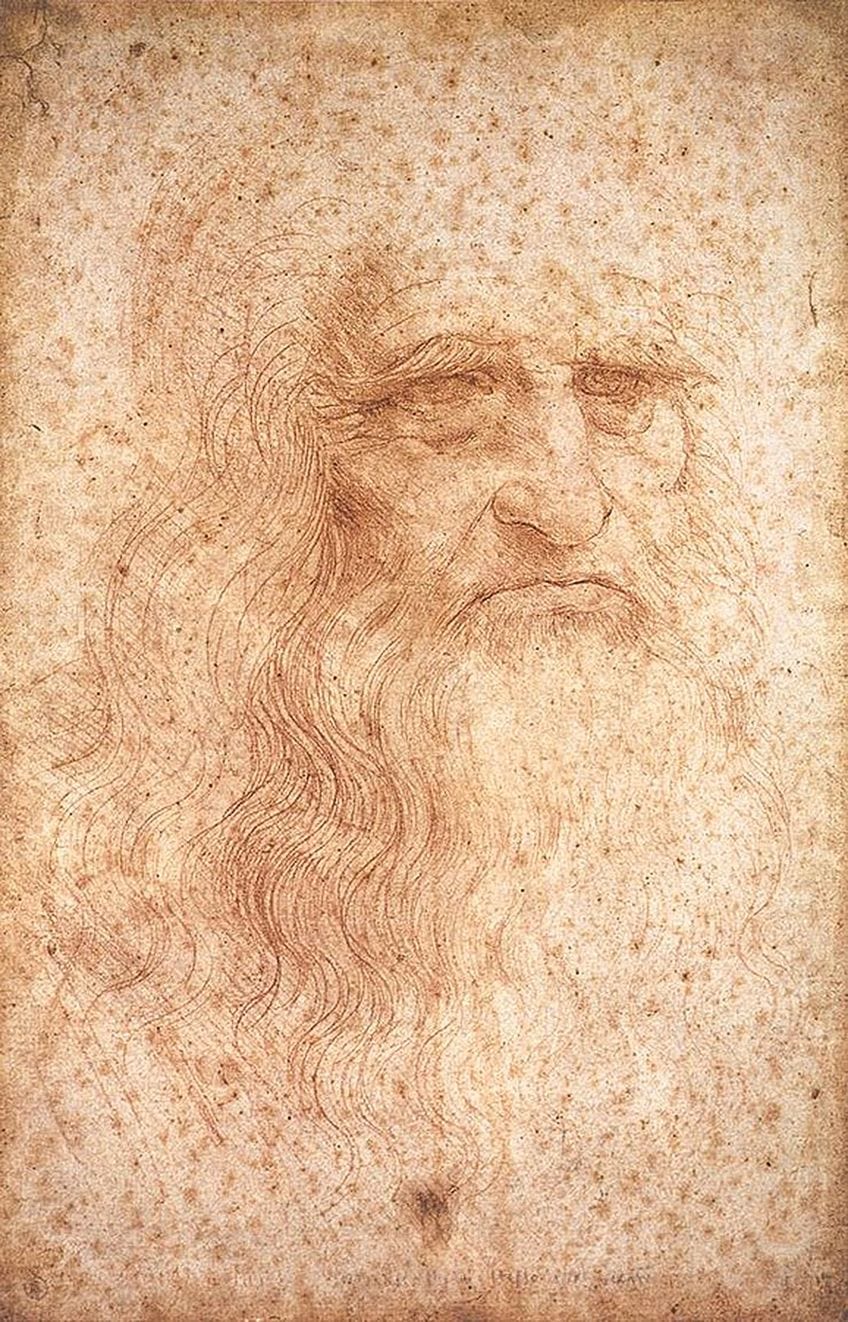 (Presumed) Self-portrait (c. 1512) by Leonardo da Vinci; Leonardo da Vinci, Public domain, via Wikimedia Commons
The Terminal Supper past da Vinci in Context
The Last Supper painting by Leonardo da Vinci is 1 of the nigh artistically astute paintings created, not only of the 15th century but in the present twenty-four hours besides – information technology is truly timeless. Below, we discuss some of the painting'south historical context and the detailed techniques used to create it. Due to diverse environmental and medium-based factors, the painting has degraded over the years and lost most of its originality. Withal, from various restorations, we nevertheless get to feel this Biblical masterpiece.
| Artist | Leonardo da Vinci |
| Engagement Painted | c. 1495 to 1498 |
| Medium | Tempera and oil paint on plaster (not fresco) |
| Genre | Religious History Painting |
| Period | Italian High Renaissance |
| Dimensions | 4.half-dozen 10 8.eight meters |
| Serial / Versions | Not applicable |
| Where is information technology housed? | Convent of Santa Maria delle Grazie, Milan |
| What It Is Worth | Not available |
Contextual Analysis: A Brief Socio-Historical Overview
The Last Supper by Leonardo da Vinci was started around 1495 and completed around 1498. Many would inquire, "Where is The Last Supper painting?" considering information technology is non housed in any of the great art galleries or museums. It was painted on the wall of the dining room, otherwise known as a refectory, of the Dominican convent of Santa Maria delle Grazie, located in Milan. It was commissioned by the Duke of Milan, Ludovico Sforza, as role of a family mausoleum reconstructed from a church. It was non a refectory at the fourth dimension that da Vinci started painting.
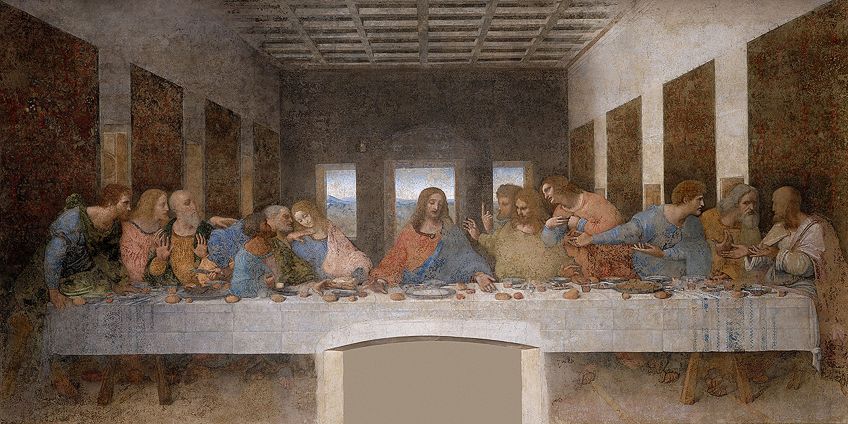 The Last Supper (restored) past Leonardo da Vinci, 1495-1498;Leonardo da Vinci, Public domain, via Wikimedia Commons
A "Serial of Unfortunate Events": The Restoration of The Last Supper
There is a history behind the restoration of da Vinci's Concluding Supper; the painting has undergone a long, arduous journey to continue its shape, so to say. Unfortunately, the process of deterioration kicked in the moment that da Vinci started painting The Terminal Supper because of certain materials he used. We will discuss this in more particular in the formal assay beneath.
The Santa Maria convent was too located in an area where in that location were higher levels of dampness every bit well equally flooding. So, the painting captivated moisture from different sources, including the steam from the kitchen. This in addition to beingness painted on a thin outside wall led to the paint starting to bit off the wall.
The painting gradually, and naturally, deteriorated from 1517, witnessed past many. When the Italian historian, Giorgio Vasari, saw the state of the Terminal Supper around the mid-1500s, he reportedly described it as a "muddle of blots". During this fourth dimension, the Italian Mannerist painter Giovanni Paulo Lomazzo as well reportedly said that "the painting is all ruined".
Restoration started around 1726 and continued until well into the 20th century.
However, the diverse restoration efforts aggravated the painting more. Some used oil paint and varnish to fill in spaces and others did away with previous restoration work and started all over again. Some restorers also tried to motion the wall to a safer location merely caused damage in the procedure, and thus tried to glue the pieces together.
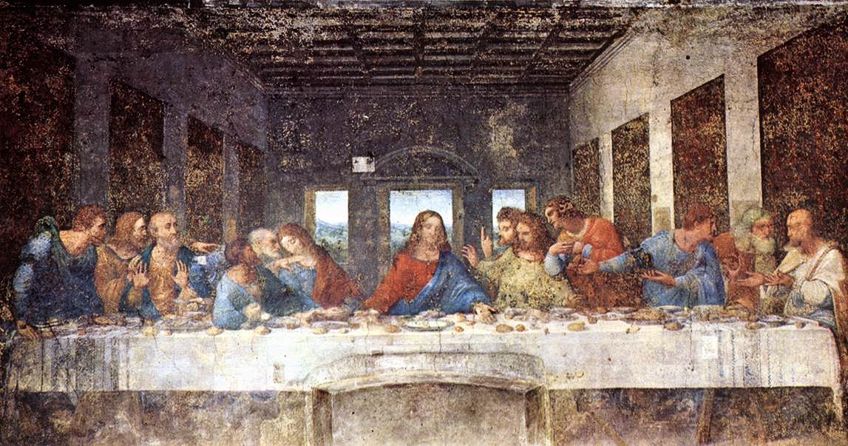 The Last Supper (pre-restoration) past Leonardo da Vinci, 1495-1498;Leonardo da Vinci, Public domain, via Wikimedia Eatables
External forces other than ecology factors also contributed to the painting's devastation. Napoleon's troops used the refectory as stables in 1796 when they took over Milan. These troops also threw stones and rocks at the painting, and some are reported to have scratched out the Apostle'southward optics. The refectory was also used as a prison at one stage.
During the early 1900s, the painting was cleaned by diverse restorers and achieved a certain level of restoration, but during World War Two in 1943, bombing in Milan left parts of the Santa Maria delle Grazie in ruins, including the refectory's roof. The Last Supper painting was protected and buffered by mattresses, sandbags, and pillows.
During the refectory'due south reconstruction, the painting was further exposed to the open surround, causing more than deposition, but restoration continued.
The painting was covered with a protective resin to prevent moisture impairment, and well-nigh of the paint from other restoration efforts throughout the years was removed. During the later 1970s, the restorer Pinin Brambilla Barcilon took over the restoration efforts on a larger scale, lasting 21 years. The restoration procedure included scraping abroad all the one-time paint from previous restorations and creating a controlled climate in the refectory.
The restored painting was finally opened to public display in 1999 with considerable criticism about the manner it appeared – at that place was contend well-nigh whether it was more "deformed" or really more than of the Concluding Supper original. Some critics like the British artist, Michael Daley, remarked the painting should not accept been restored and information technology (the restoration) left it (the painting) with a "20th-century character".
The director of the Institute of Restoration in Florence, Giorgio Bonsanti, believes the restoration has been positive. He is reported to take said, "I remember they've done a very good chore. What was in that location has been recovered; what was added has been done with complete reversibility. I call back it is far ameliorate to run across 20 percent of Leonardo's original rather than something that was a 100-percentage fake".
"The Last Supper" has certainly been an elusive painting since it was painted, mainly due to its degradation and numerous restorations. It has even been called "The Lost Supper" by some critics. Through its recent 21-year restoration, we tin see new (or but the original) aspects of this Renaissance masterpiece.
The Concluding Supper original shows us aspects that were covered up or changed earlier. For case, decorative millefleurs are seen on the drapery, and some parts of the landscape in the window behind the seated effigy of Christ take been detailed. Additionally, the original facial features of some of the disciples have changed, depicting them without beards, open up mouths, and other features similar inverse head positions, optics, and easily.
Formal Analysis: A Brief Compositional Overview
Below, we volition take a closer look at the Final Supper painting and discuss da Vinci's skill in bridging the gap between creative aesthetics, mathematics, and geometry in this composition. There is quite a lot happening in this painting and da Vinci certainly did non identify all the players haphazardly, even though they may appear as such.
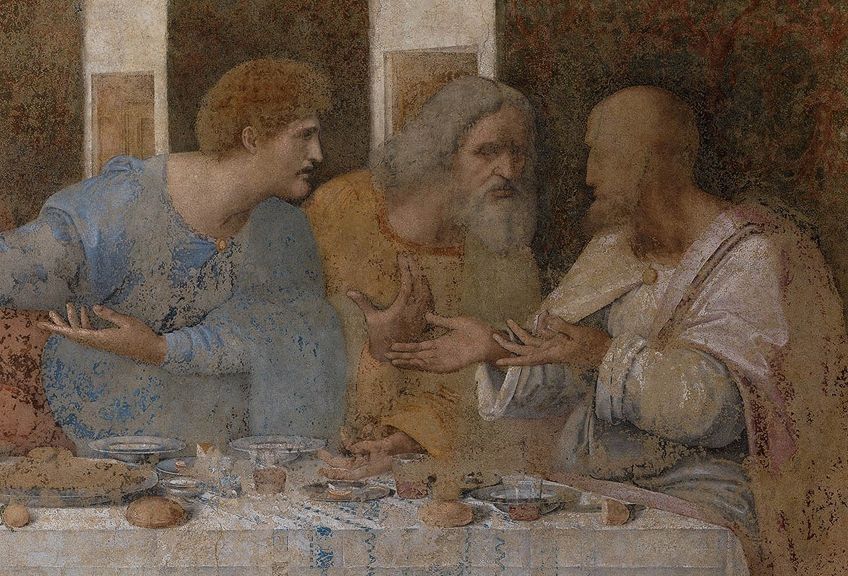 Leonardo da Vinci's TheTerminal Supper, cropped to simply evidence the 3 disciples on the far right side of the table;Katolophyromai, CC0, via Wikimedia Commons
Subject Matter
The Last Supper painting is a snapshot of the moment Christ tells his Apostles that one of them will betray him; "Very truly I tell yous, one of y'all is going to betray me," (Gospel of John thirteen:21). The painting depicts each campaigner reacting in his own unique way. This is as well taking place during the last supper with Jesus before he was given over to the authorities, who were informed by Judas.
Most of the limerick is taken up by a long horizontal table seating Christ at the heart with his twelve apostles to his left and right. The figures are all facing us, the viewers. Nosotros notice iii vertical windows backside the figures, the fundamental window being directly behind Christ, highlighting his figure and importance. The outside, seen through these windows, suggests a green and lush mountainous landscape.
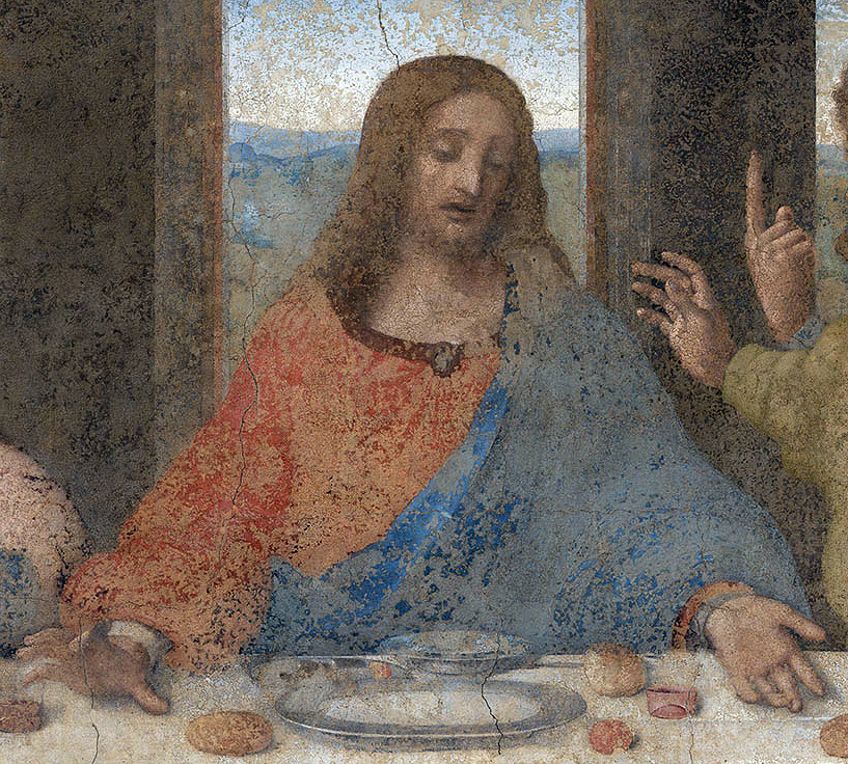 A cropped item of Christ in Leonardo da Vinci's The Last Supper (1495-1498), with the mural view from the window behind him;Leonardo da Vinci, Public domain, via Wikimedia Commons
The interior depicts a geometric architectural space with four vertical tapestries hanging on either side of the walls flanking the figures. Nigh the bottom of the painting, directly underneath the effigy of Christ, where his feet would be, is a blank department – this is where a door was cut into the refectory's wall years prior. Some sources also suggest that da Vinci depicted Christ's feet in the same manner we see when he was on the Cantankerous.
On the dining table, we observe the white tablecloth with its lacework patterning, wine glasses, water pitchers, pewter bowls, and foodstuffs similar rolls, fish, fruits, and also vino.
Seated past the table, the figures are divided into four groups of three. Originally, only the figures of Jesus, Judas, John, and Peter were identifiable, however, due to other sources (reportedly da Vinci'southward notebooks and other copies of this painting), all the figures were able to be identified. Each group also expresses a certain emotional reaction upon hearing the news from Jesus.
From the far left to the right, the first group consists of Bartholomew, James the Less (or Son of Alphaeus), and Andrew, whose hands are raised as if indicating to stop or tiresome down – all 3 characters depict emotions of surprise.
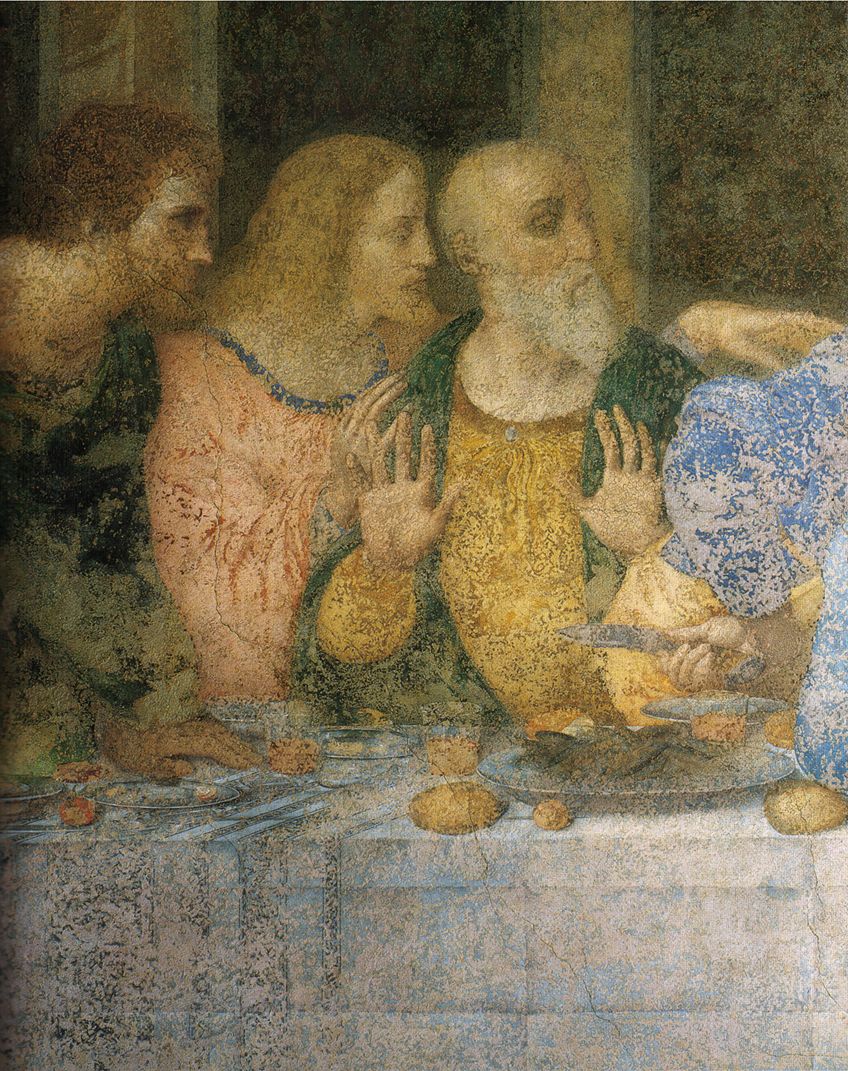 A crop of Leonardo da Vinci'southward The Terminal Supper (1495-1498), depicting Bartholomew, James the Less (or Son of Alphaeus), and Andrew on the far left; see filename or category, Public domain, via Wikimedia Commons
The side by side group starts with Peter leaning over at John, whose caput tilts to the left side towards Peter. Peter'south left hand is on John's right shoulder. John'south hands are both clasped, resting on the table. He is as well the youngest of the twelve apostles and is described as having a "swooning" disposition.
If we expect closely, we will too notice Peter's right mitt is holding a knife, but his arm and manus appear out of proportion. This has been called the "disembodied hand" because his right shoulder and elbow are non in anatomical alignment with his mitt. Nevertheless, this tin also be considering Peter seems to be resting his hand on his hip while holding the knife, which makes it appear seemingly disjointed.
Furthermore, this knife is a telling symbol well-nigh the forthcoming incident where Peter will try to defend Jesus while being arrested in the garden of Gethsemane. This is from the poesy in the Gospel of John (18: 10), "Then Simon Peter, who had a sword, drew information technology and struck the high priest's servant, cut off his correct ear. (The servant'south proper name was Malchus)".
Judas Iscariot sits adjacent to Peter, but in the painting, he appears more in front of both Peter and John. An important point to note is that Judas is unremarkably depicted separated from the other apostles in other paintings of this scene. We see this in The Last Supper (1447) by the Early on Renaissance painter, Andrea del Castagno.
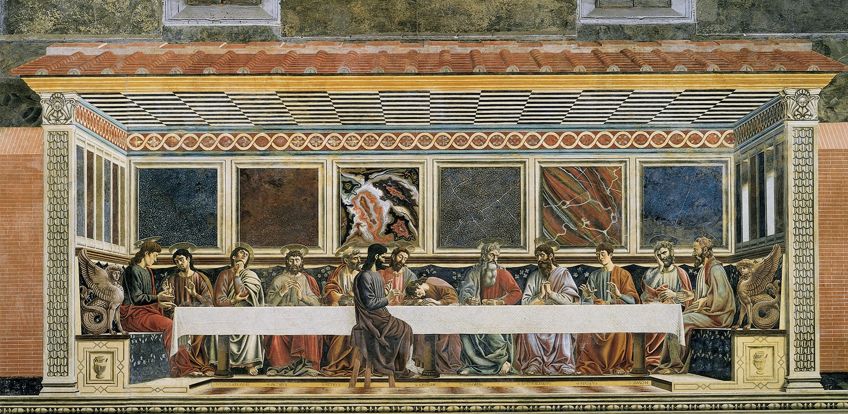 The Last Supper (1445-1450) past Andrea del Castagno;Andrea del Castagno, Public domain, via Wikimedia Commons
Da Vinci depicted him with all the other apostles, but with differences. For instance, his caput is depicted on a lower compositional level than the other apostle's heads. He is identified as wearing blue, greenish, and reddish robes. His correct shoulder is leaning on the tabular array, and he appears to be aghast or taken ashamed at the news. He is clearly on another "level" than the other apostles, which nevertheless sets him apart.
He is also clutching a money purse in his right hand, which could be the money (silvery) he received for betraying Jesus. He also knocks over a salt pot, which is a symbol of a bad omen. His left hand is reaching towards a bowl on the table and similarly, Christ'south right manus is reaching towards the same bowl.
This could hint at the Bible poesy in Matthew 26, when the disciples asked, "Surely y'all don't hateful me, Lord?" and Jesus responded, "The one who has dipped his mitt into the bowl with me volition betray me".
In the center is the effigy of Jesus Christ. His eyebrow is one of openness, suggesting his blessing of food and wine, also referred to as the Holy Sacrament and Eucharist. This is from Matthew 26 in the Bible, when Jesus says, "Take and consume; this is my body" and afterwards drinking from the loving cup, "Drink from it, all of you. This is my blood of the covenant, which is poured out for many for the forgiveness of sins".
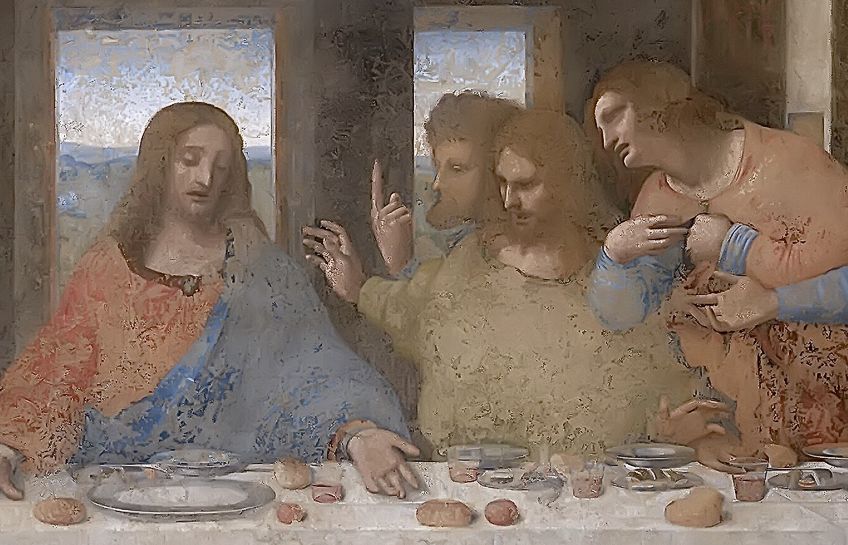 A cropped department of Leonardo da Vinci'south The Last Supper (1495-1498), depicting Thomas raising his alphabetize finger at Christ;Leonardo da Vinci, CC By-SA 4.0, via Wikimedia Commons
When we expect at the adjacent group of iii figures to the right (on Jesus' left), nosotros notice James, whose artillery are broad open, illustrating a stunned reaction. Next to him, just appearing almost backside him, is Thomas, whose only betoken of identification is his raised alphabetize finger.
The raised index finger is perchance a connexion to Christ'due south Resurrection and when Thomas needed to verify Jesus' wounds by touching them with his ain hands. Lastly, nosotros meet Philip with a questioning expression, every bit if he is urging Jesus to give him an explanation.
This again points to the verse, "Surely you don't mean me, Lord?"
The last group of three depicts Matthew and Jude Thaddeus turned towards Simon the Zealot, who sits at the far right from our view, and the far left from Jesus' side, at the end of the table. Matthew and Thaddeus are both seemingly questioning Simon and seeking some sort of answer to what is going on later on Jesus gave the news.
Geometric Symbolism In The Concluding Supper by da Vinci
We mentioned various symbolic references, particularly pertaining to the 12 apostles of Jesus. However, in that location are other symbolic references that pertain to the use of geometry and the number iii, which could refer to the Holy Trinity.
We see the latter in the iv groups of 3 apostles, the three windows in the background, and most importantly, the figure of Christ is in a triangular shape. His shape is equilateral (where all sides are equal) with the top point as his head, the 2 sides are his outstretched artillery, and the base of the triangle appears where the tabular array meets his torso.
The geometry used here also indicates the thought of divinity, which additionally includes the semi-round shape (which as well suggests a circle) in a higher place the window directly behind Christ's figure.
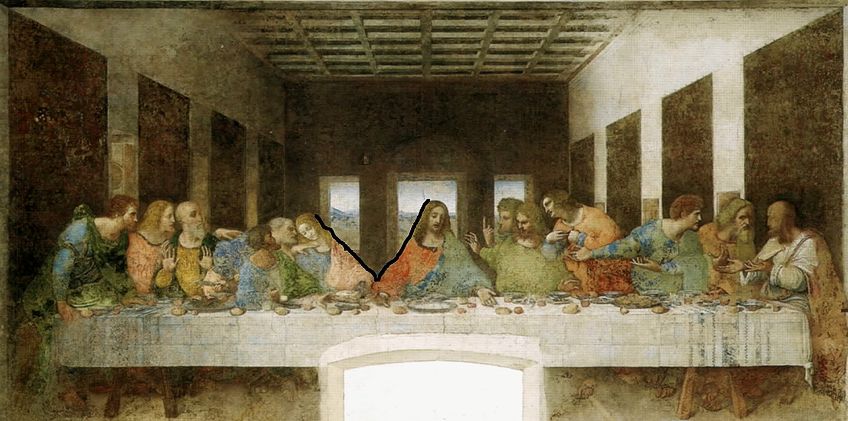 The figure of Christ in a triangular shape, which is reflected in the infinite betwixt him and John;Leonardo da Vinci, Public domain, via Wikimedia Commons
The use of geometry goes dorsum to Greek philosophy, and nosotros see here this influence on da Vinci's work. It also hints at the Neo-Platonic thought from the Renaissance flow, which was a revival of Classical philosophical thought. It was based on Plato's philosophies of the world across the material globe and the idea of perfection and dazzler, which was also adopted by various figures following the Christian ideals.
Another symbolic aspect that has been suggested is how da Vinci distinguished the spiritual and material worlds by placing the horizontal table betwixt each. The figures are likewise densely congregated in the foreground by the table, which suggests the material, earthly plane. Behind the figures is the suggestion of sky or paradise.
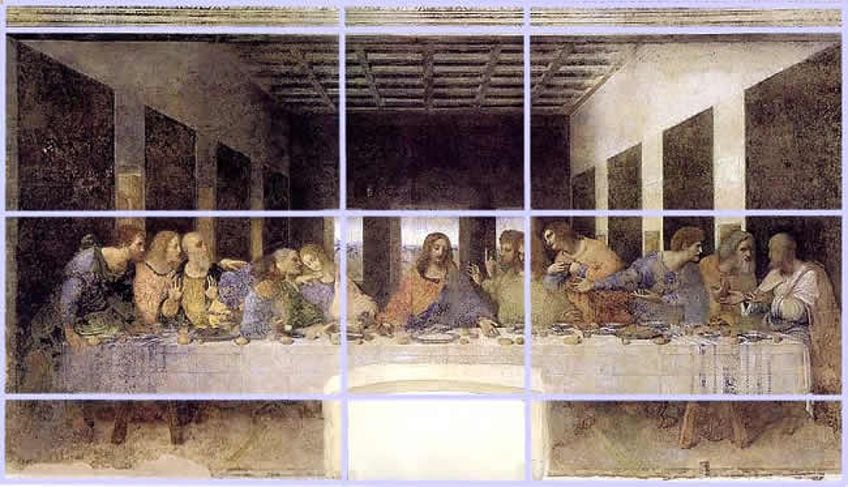 A gilded department of Da Vinci's The Terminal Supper, indicating the painting's Platonic proportions; Leonardo da Vinci, Public domain, via Wikimedia Commons
Furthermore, the simple setting of the interior also eliminates all unnecessary distractions in the painting, and nosotros are faced with only the necessary elements that suggest the existence of more beyond the material world.
Da Vinci too did not paint a halo over Jesus' caput, which we volition detect in other paintings depicting this Last Supper scene. Some sources suggest that he was not a devoutly religious man and believed in nature, which is as well supposedly why he chose to describe everyday people every bit the apostles.
Painting Technique: Color, Low-cal, and Texture
A big part of The Last Supper by Leonardo da Vinci is the choice of painting medium used. However, in the artist's endeavor to portray richer colors, this selection unfortunately contributed to the painting'due south deterioration and seemingly countless restoration efforts.
Da Vinci did non paint The Final Supper every bit a fresco. Fresco paintings are done with water-soluble color pigments applied to a fresh coat of wet plaster, and is referred to as buon fresco, significant "truthful fresh" in Italian. This technique had to exist done with efficiency and speed as the plaster would dry out within hours.
Da Vinci wanted to utilise colors that would stand out compared to fresco colors, so he combined various media like oil paints and tempera to a double layer of dry plaster.
He primed the wall with a gesso, pitch, and mastic base of operations. He practical a white pb undercoat that gave the paints more luminosity, which is a technique usually used in panel painting. This technique on a stone wall was not as successful, however, because the pigment started to flake subsequently only a few years of awarding.
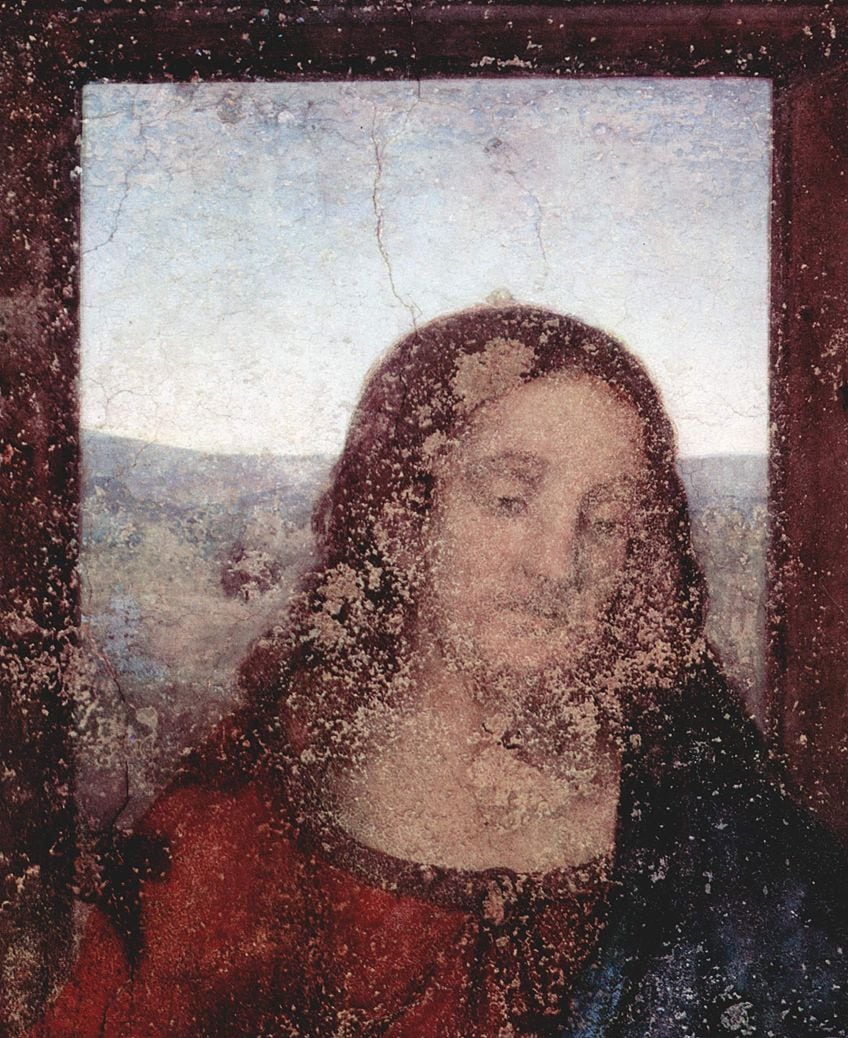 A detail of Da Vinci's The Final Supper, illustrating the painting techniques used by the artist to achieve contrasts of light and nighttime;Leonardo da Vinci, Public domain, via Wikimedia Commons
Da Vinci also utilizes the chiaroscuro and sfumato techniques to create a visual depth from the color contrasts of low-cal and dark. We meet these contrasts of light and dark particularly in the forefront of the pic aeroplane moving inwards towards the figure of Christ. The areas near the walls announced darker and more in shadow.
This technique also allowed the artist to practice away with excessive bold or sharper outlines.Sfumato, meaning "smokey," is also a technique to alloy colors with one another. This also creates a more natural gradation of tones and outlines, giving the painting an overall hazy and realistic appearance.
The texture of the painting has been described every bit "grainy and fragmented", which is reportedly intentionally washed by da Vinci, but too a outcome of the continual deterioration over fourth dimension washed to a stone wall.
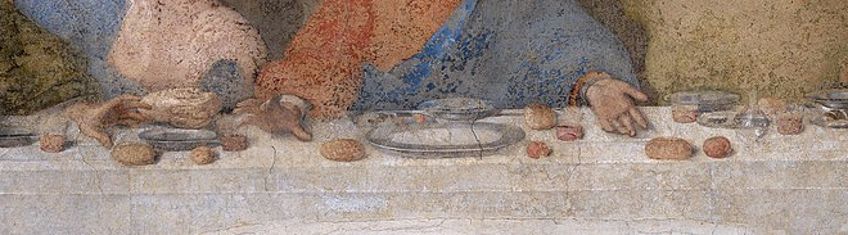 A cropped detail of The Final Supper (1495-1498) by Leonardo da Vinci, depicting the fragmented texture of the painting;Leonardo da Vinci, Public domain, via Wikimedia Eatables
Perspective and Calibration
There is a skilled utilization of lines to point perspective in The Last Supper painting. Da Vinci was a master at incorporating mathematical elements to create visual symmetry. Jesus' head is the primary vanishing betoken for the perspectival lines, also called orthogonal lines, which are part of what creates the single point linear perspective in this painting.
These as well highlight the central and most important figure of the composition, which is Christ. An interesting fact nigh da Vinci's method to accomplish one-signal perspective is that he hammered a nail into the wall to betoken where it started.
Da Vinci also uses aerial perspective in the outer landscape. It appears hazy and atmospheric, which creates a sense of depth. Furthermore, the apply of hazier colors adds to this sense of distance in the background.
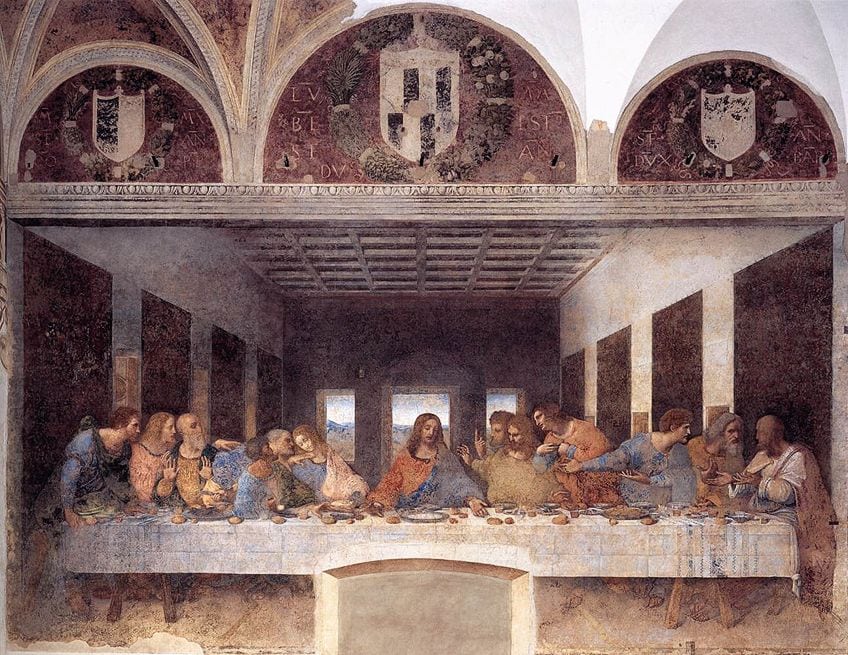 The Last Supper (1495-1498) by Leonardo da Vinci on the refectory wall of the Santa Maria delle Grazie; Leonardo da Vinci, Public domain, via Wikimedia Commons
Considering the painting has been washed on the Santa Maria delle Grazie refectory wall, information technology is large in scale, measuring iv.half dozen x viii.eight meters (29 feet in length and 15 feet in height). Along with the skilled use of perspective, The Last Supper appears as if information technology is part of the room it is painted in, and viewers seemingly become part of the supper scene.
Imagine gazing at the supper scene while having supper in the refectory, which was one of the intentions behind the symbolism of this painting, meant to accompany the friars' meals.
Facts About The Concluding Supper Painting
Beneath, we discuss a few interesting facts about da Vinci's Last Supper painting, ranging from how he used preparatory sketches to study people'southward facial expressions to important copies fabricated of the painting that help u.s. see what it may have looked similar in the very showtime. We will also talk about some conspiracy theories about the painting's symbolism and subject matter.
Da Vinci'due south Preparatory Sketches
Da Vinci made a significant number of preparatory sketches for the Last Supper painting. He is reported to accept studied diverse people and their different facial expressions and how their movements appeared. These were for his depictions of the twelve apostles.
The facial features of the twelve apostles were apparently features taken from ordinary people around Milan. Some sources too suggest that da Vinci found a real-life criminal to model the features for Judas' figure in the painting; da Vinci is believed to take visited jails in Milan to find the perfect model.
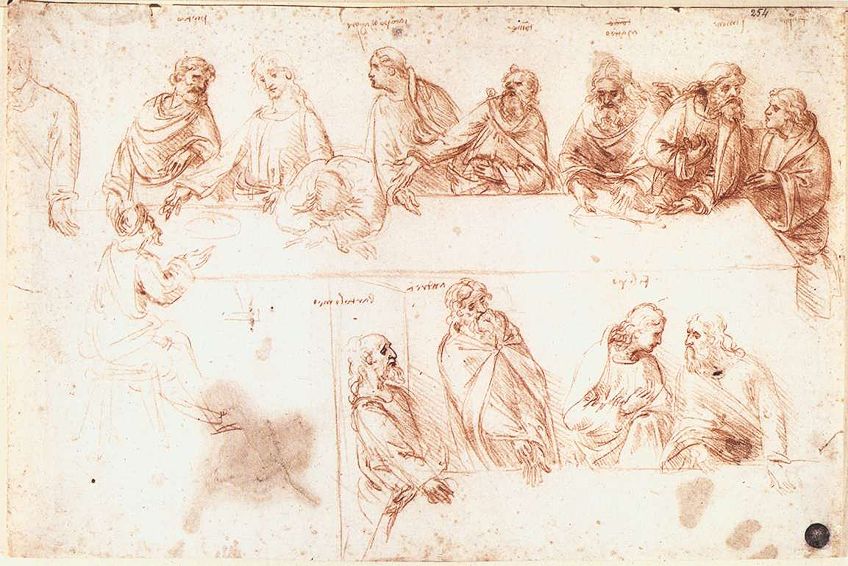 Study for the Terminal Supper (1494-1495) by Leonardo da Vinci;Leonardo da Vinci, Public domain, via Wikimedia Eatables
Copies of The Last Supper Original
Another important part of The Last Supper painting, ironically, is all the copies of the painting. At that place have been numerous copies made over the years. 2 of import copies come from the Italian painters, Giampietrino (c. 1520), which is housed in the Imperial University of Arts in London, and Cesare da Sesto (c. 1520), housed at the Church building of St. Ambrogio in the district of Ponte Capriasca in Switzerland. Both artists were believed to have been in da Vinci'southward life and circle, possibly as his assistants.
The paintings are important copies giving details near "The Last Supper" original. In fact, Giampietrino's copy was utilized as a reference for the major restoration during the 1970s.
Other, more gimmicky copies of the Last Supper painting and style have been appropriated and deconstructed by artists like the Surrealist Salvador Dalí'sThe Sacrament of the Terminal Supper (1955), Pop Creative person Andy Warhol'due southThe Last Supper (1986), Susan Dorothea White'southThe First Supper (1988), Feminist creative person Mary Beth Edelson'sSome Living American Women Artists / Final Supper (1972), and many others.
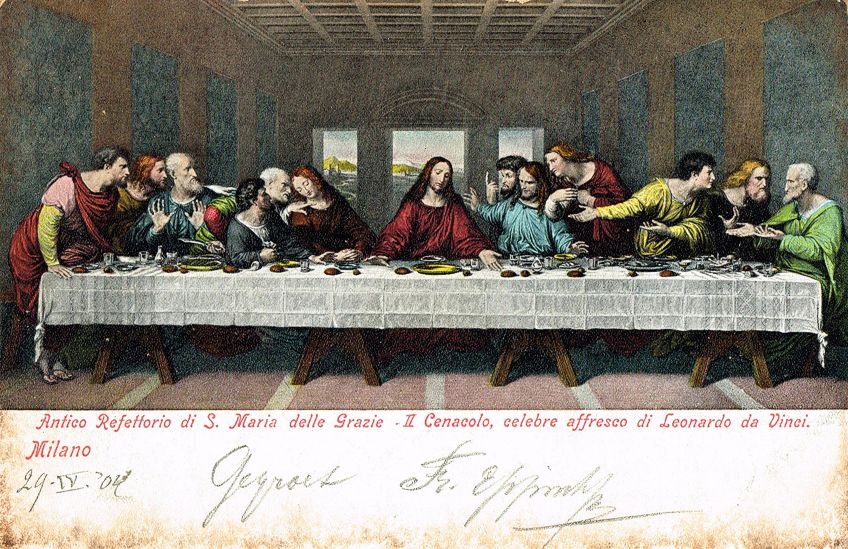 Postcard of The Last Supper by Da Vinci published in or before 1904;AnonymousUnknown author, Public domain, via Wikimedia Commons
Conspiracy Theories About The Final Supper Painting
The Final Supper by da Vinci has been the topic of numerous religious conspiracy theories, becoming a symbol of mystery with "hidden" messages. One mutual conspiracy theory worth noting is the effigy of John sitting next to Jesus's right (our left) who has been reported to, in fact, exist Mother Mary.
Almost all Final Supper paintings earlier da Vinci's version draw John in a feminine mode, and da Vinci also copied the principal characteristics of these previous depictions. We will observe John's figure always has a languid body posture, normally depicted reclining or sleeping next to Jesus. He has also been described as "the disciple whom Jesus loved" in the Gospel of John.
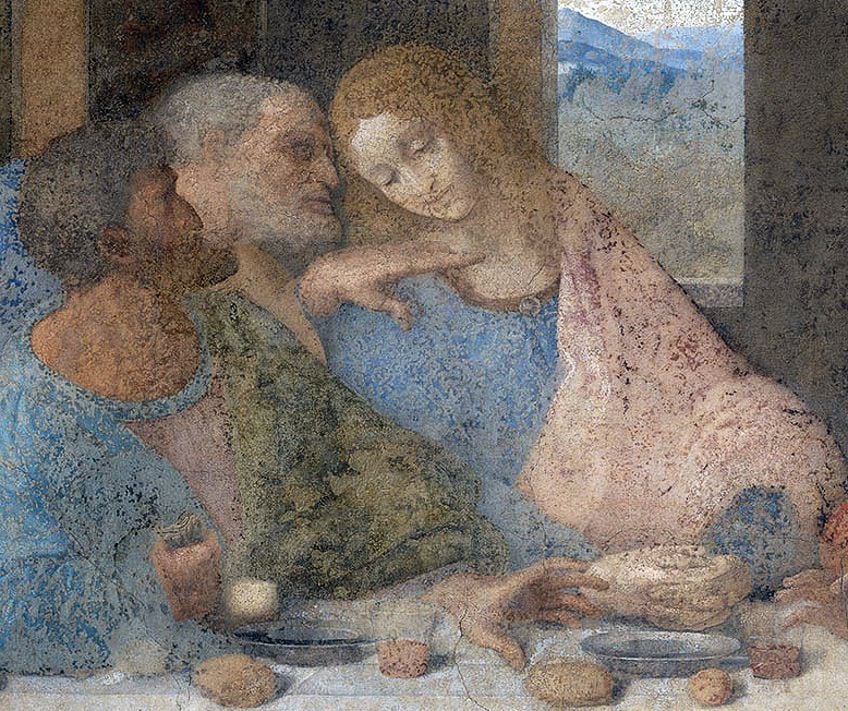 Detail of the "beloved disciple" to Jesus' correct, identified by art historians every bit the campaigner John, just speculated in the 2003 book The Da Vinci Lawmaking and similar works to be Mary Magdalene;Leonardo da Vinci, Public domain, via Wikimedia Eatables
Examples of John in other paintings include Duccio di Bouninsegna's The Final Supper (1325), Andrea del Castagno's The Last Supper (1445 to 1450), and Domenico Ghirlandaio's The Last Supper (1486), which could have been an influence on how da Vinci set out his painting.
Leonardo da Vinci was likewise known to describe his subject matter with feminine qualities.
An example is evident in his painting titledSaint John the Baptist (c. 1513 to 1516). Furthermore, Mother Mary is believed to be portrayed with the apostles in other paintings of the Final Supper, for instance, in Fra Angelico's The Terminal Supper (1442), nosotros meet a adult female kneeling in the left corner. This would make the idea of her presence in da Vinci's painting less mysterious.
Other symbols like an "One thousand" have been reported to exist embedded in the middle of the composition, which undoubtedly stands for Mary Magdalene. The books The Templar Revelation (1997) by Lynn Picknett and The Holy Claret and the Holy Grail (1982) by Michael Baigent, Henry Lincoln, and Richard Leigh were also influential in furthering this "speculation". The Da Vinci Code (2003) by Dan Brownish has also been a pop-cultural influence introducing and expanding on many of the in a higher place-mentioned theories.
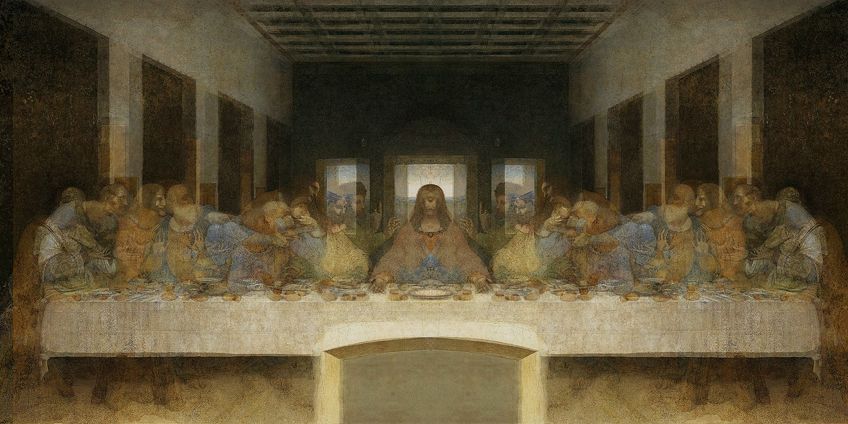 This image was created with no alteration in contrast at 50% transparency overlaid every bit a mirror image. The secret images in Da Vinci's The Last Supper are made visible past the application of Da Vinci'south archetype "Looking Drinking glass Code." The original image as seen through a mirror is overlaid onto the original painting. The implications of the novel, The Da Vinci Code in regard to censorship of the story of Mary Magdalene, are clear… The Holy Grail is faded but clearly outlined every bit a large, ornate Chalice serving as the centerpiece of the tabular array. Looking at each badly wounded hand of Jesus Christ, you can wait up to his face and notice his gaze has followed yours, changing from i manus to the other. Leonardo Da Vinci appears in a self-portrait, wearing a metal helmet, on both outer edges of the sail, eye to eye with the viewer;Rikfriday, CC BY-SA 3.0, via Wikimedia Eatables
Standing the Tests of Time
The Last Supper painting is a testament to the skill and precision of one of the all-time Renaissance artists, Leonardo da Vinci, who painted and depicted a famous scene in Christian art – that of the Biblical Last Supper.The Last Supper painting has, furthermore, been through almost everything a painting can become through, and probably should not go through.
From deterioration, devastation, numerous restorations, and countless speculations, information technology remains intact on the refectory wall of Santa Maria delle Grazie. It is now protected in the climate-controlled room, allowing only several visitors at a time to view information technology for a few minutes.
Take a await at ourThe Last Supper painting webstory hither!
Ofttimes Asked Questions
Who Painted The Last Supper?
The Biblical scene where Christ has his final supper with his disciples has been the subject of numerous paintings done throughout European history and Christian fine art. There have been many artists who painted the Last Supper scene, even so, High Renaissance creative person Leonardo da Vinci's The Last Supper, started around 1495 and completed around 1498, is one of the more than popular versions.
Where Is The Last Supper Painting past Leonardo da Vinci?
The Last Supper painting past Leonardo da Vinci was painted on the wall of the dining room (or refectory) in the Dominican convent of Santa Maria delle Grazie, located in Milan. Information technology was commissioned by the Knuckles of Milan, Ludovico Sforza, equally part of a family mausoleum reconstructed from a church building. It was non a refectory at the fourth dimension da Vinci started painting.
Why Is The Last Supper past da Vinci Falling Apart?
Since da Vinci started painting The Last Supper, information technology started deteriorating because of the materials he used. The refectory of the Santa Maria Convent, where the painting is housed, is also located in an expanse with college levels of dampness and prone to flooding. The painting absorbed moisture from different sources, including the steam from the kitchen. It was also painted on a thin exterior wall and the pigment started flaking off the wall.
Does Jesus Take Feet in The Last Supper by da Vinci?
Yes, merely during the 1650s, a door was cut into the refectory'due south wall right underneath the effigy of Jesus, which also cut out his feet. In other copies of The Last Supper painting, we can come across Jesus' anxiety, such equally in Giampietrino's The Last Supper (c. 1520), which is housed in the Royal Academy of Arts in London.
Source: https://artincontext.org/the-last-supper-da-vinci/

Post a Comment for "The Last Supper Painting 5 Visual Elements of Art"